The technology channel used to run in a straight line. A vendor sold to a distributor, the distributor sold to a reseller, and the reseller sold to the end customer. Cloud broke that line, and AI has scrambled what was left of it.
“Everybody’s going to everybody,” says Sanjib Sahoo, president of Ingram Micro’s Global Platform Group. In his telling, what was a linear chain has become a spider web.
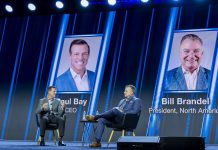
I sat down with Sahoo at Ingram Micro ONE 2026 on Nov. 16, the day before his Nov. 17 keynote, “Connecting Intelligence,” at the Gaylord Rockies in Aurora, Colo. His argument is that the channel’s hardest problem has shifted from fulfillment to finding demand in a market so tangled that no single player can see all of it. And he believes Ingram Micro, which by his count processes 250 million signals every day, can help MSPs see a lot more of it than they can on their own. The easiest starting points, he says, are the Ingram Micro MCP server and the company’s XI Hub.
Why a distributor wants to be the connective layer
Sahoo’s case rests on neutrality. “You cannot solve complexity by adding more complexity,” he says. In his view, the channel needs a connective layer that doesn’t favor any one participant, and most of the big players can’t fill that role. “No vendor can do it because they have their products. No hyperscaler can do it because they have their clouds.”
That’s the role Ingram Micro is going after. At its Capital Markets Day in September, the company described its goal as becoming the industry’s B2B intelligent operating system. Sahoo compares it to the operating system on your phone. You probably can’t name the version you’re running, and you don’t care, as long as everything works. “We are moving from being a distribution company to actually being an intelligence platform,” he says.
The raw material is scale and history. Sahoo cites 1,500 vendors, 165,000 partners, 47 years of transaction history, a four-petabyte data mesh, and 400 AI models built in-house. He’s quick to add that the models aren’t the hard part. “Models can be rented, AI can be rented,” he says. “The context is extremely important.”
Or, as he puts it more simply: “We change from moving products to moving intelligence.”
What Sahoo put on the screen
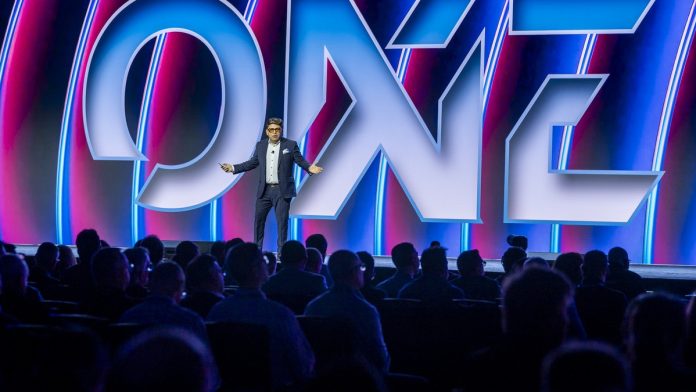
The next morning, Sahoo took that argument to the main stage. One slide read, “AI models can be replicated. Operating context cannot.” Another, titled “We have built the patented technology moat,” laid out the layers behind it: more than four petabytes of data in a real-time data mesh handling 250 million events a day, more than 400 AI and machine learning models, 42 million lines of code, and eight approved patents with more than 30 in process. He told the audience that works out to about 3,000 signals a second.
“Demand doesn’t start with an order. It starts with a signal,” Sahoo said, pointing to renewal requests, transactions, and financing requests as examples. He also took apart the acronym that kept coming up at the event. Anybody can get a model, and anyone can get a protocol, he said. The difference is “the C. The context.”
For MSPs, the practical takeaway is that Ingram Micro is betting its edge on data you can’t easily get elsewhere, not on the AI models themselves. Those figures are Ingram Micro’s own, so judge them by what the connection actually surfaces for your business.
Two ways in: the Ingram Micro MCP server and XI Hub
The next question is how MSPs get at that intelligence. Sahoo points to two options Ingram Micro introduced in August: an MCP server and the Xvantage Integration (XI) Hub. Both lean on work the company has since patented. In October, Ingram Micro received a U.S. patent for a framework that lets partners connect using the systems and data formats they already have, instead of going through a custom integration project. (Managed Services Journal covered it in “Ingram Micro patents framework to cut partner integration work.”) “You have a database, you have a system, you don’t need an integration,” Sahoo says. “We can connect with you through our framework and MCP to bring that to us.”
The MCP server is aimed at MSPs that already use an assistant such as Claude or ChatGPT. Sahoo says connecting takes 30 seconds to a minute. After that, the MSP can question Ingram Micro’s data in plain language. “An MSP can ask, where do I find my next opportunity? Give me a renewal opportunity. What are my top 10 growth opportunities?” he says. “They don’t have to go and invest in their own AI or build system integration.”
Ingram Micro is now attaching numbers to that pitch. In its Nov. 17 ONE 2026 announcement, Ingram Micro said CEO Paul Bay noted at ONE that channel partners actively using its MCP server are growing their business with Ingram Micro at nearly 4x the rate of those not integrated with Xvantage. The same release says the MCP server puts live pricing, availability, quoting, ordering, invoicing, subscriptions, and renewals inside the AI agents partners already use. The growth figure is Ingram Micro’s internal measure, not an independent benchmark, and it doesn’t prove the MCP server caused the growth.
The XI Hub is for MSPs with more established systems. Sahoo describes it as something like an app store, and a partner quoted in Ingram Micro’s August announcement credited it, along with the MCP server, with secure connections to preferred RMM and PSA platforms. He says hooking up a system such as Salesforce can take less than 30 minutes.
Which option fits depends on where the MSP is today, and Sahoo used a treadmill to explain why. Someone who has never worked out shouldn’t start at 15 miles an hour. “If I’ve not worked out ever, I’ll start with two miles an hour,” he says. “If I give XI to a small MSP, they don’t know what to do.”
From a plan to a quote
Getting connected is only the first step. Putting AI solutions together is its own challenge, Sahoo says. A single solution can span six or seven layers, including hardware, models, applications, and networking, and every layer keeps changing. Working out which GPU server, security product, and cloud service fit together is hard to do one deal at a time. “So everybody’s selling bespoke solutions one by one,” he says.
Ingram Micro splits that problem in two. Ingram Micro’s Enable AI program covers the planning. “Enable AI is like an advisory coaching maturity model that tells you how you should go about your AI journey,” Sahoo says. “And the platform and intelligence is how you execute.”
His example is an MSP that wants to build a solution for a classroom of 100 students, or for a hospital. The framework lays out the layers that solution needs, such as desktops, Microsoft 365, Copilot, networking, and servers. The platform then recommends a bundle of products that work together and produces an exact quote the MSP can take to market.
Opportunities that come to you
Most distribution still runs on a pull model. A partner comes to a platform and places an order. Ingram Micro’s SMB Quick Buy, which launched in the U.S. with Cisco and its Meraki portfolio and is now live, speeds that up with click-to-buy configurations.
The next step, Sahoo says, is a push model. Agents spot an opportunity and bring it to the MSP through a mobile alert, the platform, or a phone call. “We are going from reactive demand to proactive demand,” he says.
That only works if the opportunities fit. Sahoo says Ingram Micro matches them to each MSP’s intent and propensity, meaning what it sells and who it sells to. When I asked whether that means an MSP that doesn’t sell into the public sector won’t hear about public-sector deals, he agreed. The idea, he says, is “using the intelligence to understand the intent and propensity for that MSP and then doing the match,” rather than “just blindly calling in.”
Cisco is first, but Sahoo says the technology isn’t tied to one vendor. “The more vendors share the intelligence with us, we can do it for any vendor,” he says.
Selling AI vs. using AI
All year, I’d been hearing statistics showing MSPs were interested in AI, but few were making money from it. That may be shifting. In Ingram Micro’s ONE 2026 announcement, Omdia Chief Analyst Jay McBain said the gap between AI-services demand and partner readiness “has narrowed significantly, with 56 percent of partners now reporting advanced or developing practices.”
When I asked Sahoo whether that matches what he’s seeing, he split the question in two. “One is make money using AI and make money selling AI,” he says. “Two different things.” He also questioned whether the 56% reflects partners selling AI or using it. Selling AI is already happening, driven by demand for GPUs and other solutions. Using AI to run the business is where he sees an edge for smaller MSPs.
“It is harder the bigger you go,” Sahoo says. Larger organizations have more systems, more processes, and more change management to work through. A small MSP can move quickly with simple tools. “Even loading an Excel sheet in ChatGPT, they can still get a lot of intel.”
The catch is that an MSP’s own data only shows its own customers. “What they miss out is they get the intelligence only [from] the business they view from their lens,” Sahoo says. Combining that view with Ingram Micro’s wider channel data, he argues, is how MSPs spot the trends and demand they’d otherwise miss.
Where to start
Sahoo’s pitch to MSPs is to treat Ingram Micro as a source of intelligence first and a source of products second. “Complexity is our job,” he says. “We fix complexity.”
The easiest way to test that claim takes about a minute. If your team already works in Claude or ChatGPT, connect it to the MCP server and ask where your next renewal or growth opportunity is. Keep a simple log for 30 days: how many suggestions you acted on, and how many turned into quotes. If the answers point to deals you hadn’t spotted, the XI Hub and Enable AI are the logical next steps. If they don’t, you haven’t lost much.
Sahoo closed his keynote with a line that works as a deadline: “The time to act is finite.”