In the early days of managed services, email security was often treated as a digital hygiene issue – a way to keep spam out of inboxes and prevent the occasional nuisance virus. Those days are long gone. Today, the inbox is the primary battleground for organizational survival. It is the most porous part of the perimeter and the most frequently targeted entry point for attackers.
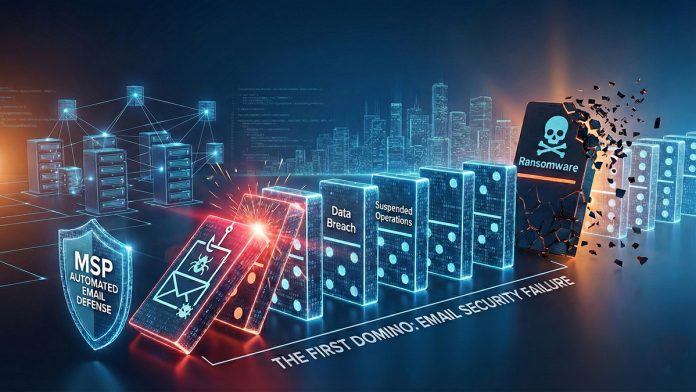
In the analysis of the modern cyber threat chain, email security is no longer regarded solely as a utility; it is considered the “first domino.” Should that domino fall, it triggers a cascade of events that can lead to data breaches, suspended operations and significant financial losses. For Managed Service Providers (MSPs), recognizing this shift is essential. The distinction between a minor incident and a significant security breach frequently hinges on the MSP’s ability to safeguard that first domino.
According to the 2025 Barracuda Email Security Breach Report, the correlation between email failures and wider systemic collapse is undeniable. The data paints a stark picture: 78% of organizations experienced an email security breach in the previous 12 months. But the breach itself is rarely the end of the story. It is usually just the opening chapter.
The cascading cost of a single click
The most alarming finding in our recent research is the tight coupling between email compromise and ransomware. The report found that 71% of organizations that experienced an email security breach were also hit by ransomware that year.
This statistic serves as a wake-up call for MSPs and their customers. It suggests that email is not merely a threat vector; it is the primary catalyst for the most damaging attacks in the industry. When attackers bypass a gateway, they aren’t just looking to steal credentials; they are looking to establish persistence, escalate privileges and deploy payloads that compromise the entire business.
The financial implications of this chain reaction are severe. Our data shows that the average cost of responding to and recovering from an email security breach is $217,068. This figure accounts for forensic investigation, remediation and downtime, but it doesn’t fully capture the long-term impact on trust. We found that 41% of breached organizations suffered reputational damage and many reported losing new business opportunities as a direct result.
For an MSP, these numbers represent a critical conversation starter. Customers often view security as a line item in a budget. By highlighting the causal link between a simple phishing email and a quarter-million-dollar loss – plus the potential for ransomware – MSPs can reframe email security as a form of business continuity insurance.
The race against time: Why speed is survival
If the first domino falls, the only thing that can stop the chain reaction is speed. Unfortunately, most organizations are falling behind.
The threat landscape has evolved toward advanced evasion techniques. Attackers are no longer sending generic, misspelled spam. They are using social engineering, conversation hijacking and zero-day exploits designed to bypass traditional filters. Consequently, 47% of organizations cite advanced evasion techniques as the primary obstacle to rapid incident response.
This complexity leads to dangerous delays. Our report indicates that only 50% of organizations detected a breach within an hour. While an hour might seem fast, in cyber time, it’s an eternity. The data reveals a terrifying “cliff” regarding response times: Organizations that took nine hours or more to fix a breach had a 79% chance of also being hit with ransomware.
The window of opportunity to prevent the dominoes from falling is very narrow. Once an attacker has nine hours of dwell time, they have likely moved laterally, compromised backups or exfiltrated sensitive data.
This creates a significant burden on MSPs. Many service providers are grappling with internal skills shortages and a fragmented toolset. 44% of respondents cited a lack of automated incident response as a primary reason for the delayed detection, containment and removal of threats. When analysts have to manually correlate data between the email gateway, the endpoint and the network, the adversary wins.
Building a platform-based defense
To prevent the first domino from tipping, MSPs must move beyond disparate, perimeter-focused tools and adopt a unified, platform-based security architecture.
Resilience today requires integration. Email telemetry cannot exist in a vacuum; it must be fed directly into broader threat detection and response systems (XDR). When email security is embedded into the core of a cyber resilience strategy, it enables three critical capabilities:
- Real-time Threat Intelligence: By leveraging data from millions of protected inboxes, MSPs can identify and block emerging threats before they reach the customer.
- Automated Remediation: We cannot rely on manual intervention to beat the “9-hour cliff.” Automation allows for the instant removal of malicious emails from all users’ inboxes the moment a threat is detected, drastically reducing exposure.
- Contextual Response: A platform approach allows MSPs to see the full picture. If a user clicks a malicious link, the system should not only block the site but also scan the endpoint for malware and automatically reset the user’s credentials.
The data is clear: The organizations that struggle most are those relying on manual processes and siloed tools. By implementing a cohesive ecosystem in which email security integrates seamlessly with the rest of the stack, MSPs can deliver measurable value.
The first domino doesn’t have to fall. By shifting the focus from simple blocking to comprehensive, automated resilience, MSPs can protect their customers from the devastating cascade of ransomware and reputational harm, ultimately differentiating their services in an increasingly competitive market.