AI has moved beyond experimentation to become a true engine of scale, redefining how global businesses compete. As generative models and edge computing go mainstream, they’re placing unprecedented new demands on the digital infrastructure beneath them.
At the heart of that transformation sits the data center.
Once largely invisible to the broader economy, data centers have become mission-critical assets. These facilities must be designed, built, powered, cooled, secured, and continuously maintained to keep AI systems running at scale. For organizations investing billions in AI-driven growth, the question is no longer whether they need more data center capacity, but how quickly they can build and operate it without introducing risk.
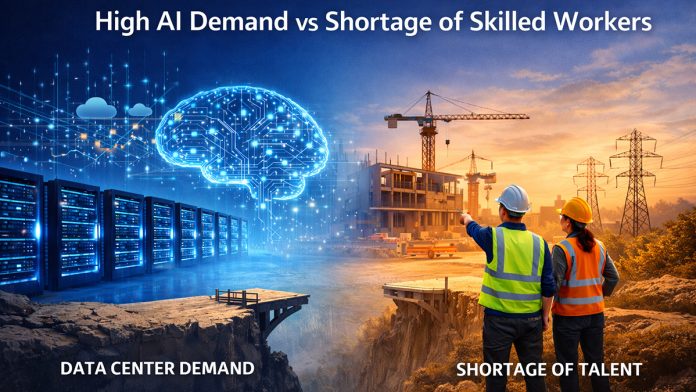
That urgency places unprecedented pressure on one of the most difficult variables to control: talent. As AI drives explosive growth in data center construction and expansion, organizations are discovering that access to the right engineering, construction and facilities expertise can determine whether projects move forward or stall.
How AI’s explosive growth is redrawing the data center map
AI adoption is reshaping economies and societies at a pace few technologies have ever matched. As organizations generate and process exponentially more data, the demand for secure, high-performance computing environments continues to surge. Cloud adoption, IoT proliferation, and AI workloads now require data centers with greater density, redundancy, and resilience than ever before.
ManpowerGroup and Uptime Institute research underscores the scale of this shift:
- Global data center capacity is projected to grow at roughly 15% annually, yet even this pace may fall short of meeting AI-driven demand.
- Power consumption is rising sharply, with global data center energy usage expected to increase by 50% by 2027.
- By the end of the decade, energy demand could surge by more than 165%, driven largely by AI workloads.
- Approximately 10 gigawatts of new IT load are being added globally to support generative AI, further intensifying infrastructure requirements.
To keep pace, data center growth is expanding beyond traditional hubs. According to a recent Cushman & Wakefield report, while established markets like Northern Virginia and Dallas remain critical, new facilities are increasingly being built in emerging and rural markets. From Pennsylvania and the Carolinas to Texas, Oregon and the Midwest, these new markets offer land and power availability that can support large-scale builds.
But these locations introduce a new challenge: specialized talent pools are often thin or fragmented, even as the complexity of operations, construction and design continues to rise.
From talent scarcity to sustainability:
The challenges facing data center growth
For data center owners and operators, AI-driven growth brings a unique convergence of pressures:
- Speed to market is critical. Delays in construction, commissioning or ongoing operations can rapidly escalate costs on already capital-intensive projects.
- Specialized skills are scarce, particularly in rural or emerging markets where many new data centers are being built.
- Sustainability and efficiency expectations are rising, requiring expertise in power optimization, HVAC systems, energy management, and environmental controls.
- Workforce costs must be tightly managed to offset rising capital and energy investments while maintaining uptime and performance.
- Operational risk is nonnegotiable. Data centers must function continuously, with little margin for error once they live.
In the U.S. alone, data center growth helped create an estimated 4.7 million jobs between 2017 and 2023, with each direct role generating up to 7 ancillary jobs in surrounding communities. Today, these numbers are exploding.
This scale of impact is both an opportunity and a challenge, particularly when projects require rapid ramp-up of engineering and facilities of talent in locations where such expertise may not already exist.
In this environment, with widespread talent scarcity, companies need a proven data center staffing partner. To maintain the rapid pace of growth, data centers require a provider that understands not only staffing but also the operational realities of building and running highly complex infrastructure.
What a future state looks like with the right workforce partner
As demand for AI accelerates, leading data center operators are rethinking how they approach talent. In a future-ready operating model, engineering, construction, and facilities expertise is no longer sourced on a project-by-project basis. Instead, it is supported through a full-service workforce solutions partner aligned to the entire data center lifecycle.
With the right partner in place, operators move from reacting to talent shortages to building with confidence, operating with control and planning for sustained scale. In practice, that future state is defined by several key capabilities:
- Build faster, with less execution risk
Access to pre-qualified engineering and construction talent enables operators to ramp up teams quickly for builds, expansions, and retrofits, even in emerging and rural markets where local expertise may be limited. Faster mobilization helps keep projects on schedule and reduces costly delays during critical build phases.
- Operate reliably from day one
Facilities and critical environment professionals are embedded early to support commissioning, transition and steady-state operations. This continuity reduces handoff risk, preserves institutional knowledge, and helps ensure uptime once sites go live.
- Scale with predictability, not volatility
A full-service workforce partner enables proactive workforce planning, aligning labor supply with construction timelines, operational demand, and future expansion. Data center organizations gain the flexibility to scale up or down without destabilizing costs, performance, or safety.
- Optimize and modernize continuously
Specialized expertise in power systems, cooling, energy optimization and facilities management supports ongoing improvement. Operators can modernize infrastructure, improve efficiency, and meet rising sustainability expectations without disrupting live environments. - Reduce operational and workforce risk
Staffing strategies are built around redundancy, compliance and continuity, not last-minute hiring. This approach reduces exposure in an environment where downtime, skill gaps, or safety incidents are unacceptable.
In this future state, workforce strategy becomes an infrastructure strategy. By partnering with a provider that understands both the complexity of data center operations and the realities of scarce technical talent, operators can shift from being constrained by labor availability to being positioned for sustained, AI-driven growth.
Building tomorrow’s data center infrastructure with the right talent
AI is redefining what’s possible, but only if the infrastructure behind it can keep up. In the age of AI, data centers sit at the intersection of technology, energy, and human expertise. The organizations that succeed will be those that treat engineering, construction and facilities of talent as a strategic asset, not a constraint.