
Curt Vurpillat’s title slide at Ingram Micro ONE 2026 made a claim that should get every MSP’s attention: “Your customers already have an AI strategy (whether they know it or not).”
Vurpillat, who ran an MSP for more than a decade before joining Ingram Micro, explained what he meant during his Nov. 17 breakout. Some companies have deliberately chosen tools and built agents. Many more have simply ignored AI. “Well, that’s a strategy,” he says. “Your strategy is to ignore it.” Either way, AI is already inside the business, and the MSP that helps the customer take control of it has a natural path to the next project.
Three ways AI gets into a business
Vurpillat described three routes, and MSPs need a plan for each.
The first is sanctioned AI, the tools a company buys on purpose, like Microsoft Copilot licenses or computer vision on a manufacturing line. The second is AI built into software customers already pay for, as platforms like Salesforce and SAP add features that users may never inventory or think about from a data perspective. The third is shadow AI, the tools employees bring in on their own. Vurpillat cited data suggesting about 80% of people bring some form of AI to work.
His first practical fix is simple. Find out which AI licenses employees are using and move them from free or consumer plans to business plans. The tools often work the same, he said, but business plans typically include contractual commitments that submitted data won’t be used to train the provider’s model.
Security basics matter more, not less
Much of AI security, in Vurpillat’s view, is good security practice applied with more urgency. Identity is the real perimeter. MFA, least-privilege access, network visibility, and patching all still apply.
Least privilege deserves special attention. An AI agent usually has access to the same files as the user it works for, but it can find and process them far faster than a person. Organizations used to rely, without saying so, on employees not knowing where broadly shared files lived. That doesn’t work when an agent can search everything in seconds. Vurpillat also warned that AI tools are making long-standing software bugs easier to find, so patching browsers, firewalls, and security products quickly matters more than ever.
A guardrail customers will remember
Vurpillat compared an AI agent to a new employee: it follows instructions, and an agent told to do “whatever it takes” may do more than its owner intended. His rule of thumb is one MSPs can repeat to any customer: “Any time there’s a send or spend, somebody should take a look.”
Other ONE sessions drew similar lines. On a partner panel the next day, John Zarei, CEO of Point Alliance, said he’s comfortable letting agents read and analyze information, produce reports, and create tasks, but not handle high-value transactions, money transfers, sensitive customer data, or network changes without a person. Microsoft took a similar approach in a session on Windows agent security. A low-risk research agent that drafts content gets light containment, while a security agent that can quarantine devices runs in full isolation.
Sell the outcome, then measure it
The second half of Vurpillat’s talk focused on what customers are actually buying. He suggested organizing every AI opportunity around one of three purposes: organize data (it finds the answer in your own documents), automate a process (the email gets read and the reply gets drafted), or inform a decision (a person still makes the call).
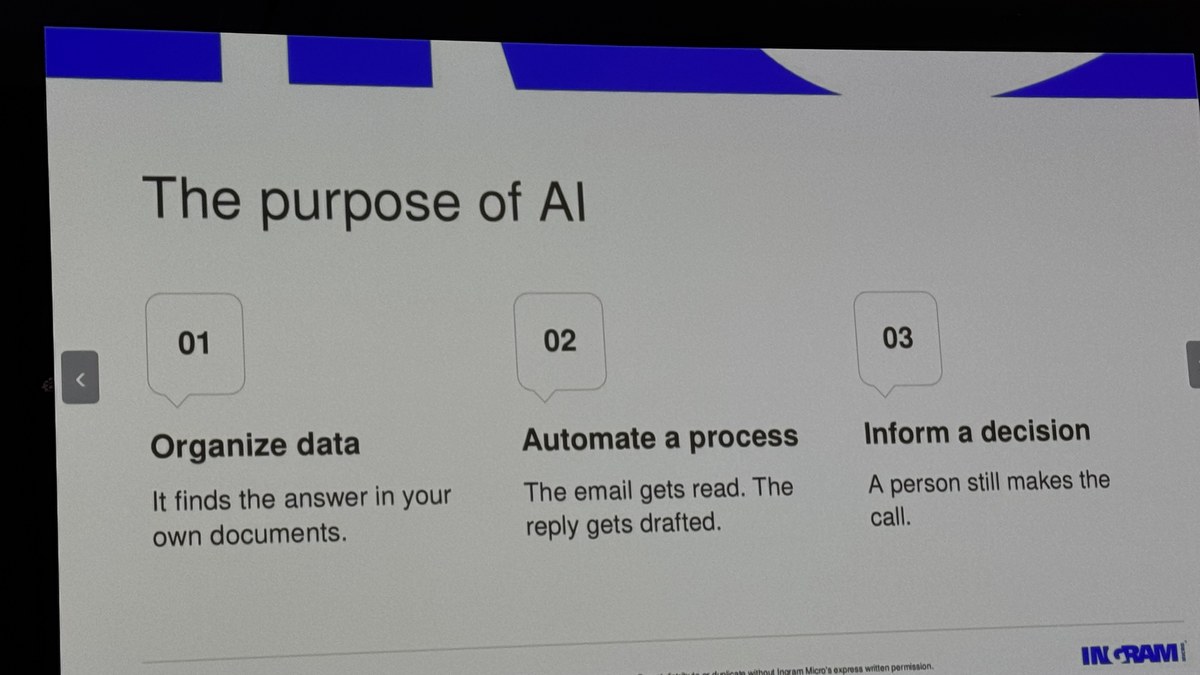 Vurpillat’s slide at Ingram Micro ONE 2026 sorts AI use cases into three purposes.
Whichever one it is, define success before you start. Vurpillat said about 70% of early manufacturing computer-vision projects never reached a second phase. Many failed because no one decided upfront what success looked like or whether the benefit was worth the cost and effort. Finding 40% more defects sounds good, he said, but only matters if it’s worth what the customer is paying.
He also noted that customers may not see an existing workflow as a problem if it has “always worked.” A hospital employee who spends all day reworking denied insurance claims by hand is doing their job. Showing that AI can draft the fix and leave the person to approve the exceptions is an improvement the customer may not ask for on their own.
Where the MSP comes in
Vurpillat’s slides walked through use cases by industry, each rated by effort and risk: quality inspection on a plant floor, claim denials at a medical practice, legal research at a law firm, proposals at a professional services firm, and short marketing videos for a small business. Across all of them, the MSP’s role followed the same four steps.
- Sell it. Start with business-plan seats or a workflow improvement the customer can picture.
- Define it. Agree on the outcome and the metrics before anything is deployed.
- Secure it. Set the policy, identity controls, and visibility, and keep a human on every send or spend.
- Deploy it. Give each agent its own identity and treat it like a new hire on probation, expanding what it can do as it proves itself.
He also listed three things every customer needs, whatever their maturity: a one-page AI policy that says what can go in, what can’t, and who to ask; a survey of existing AI use, with what he called full amnesty so employees are honest; and use cases explored with the people who do the work, not IT alone.
MSPs don’t have to write that policy from scratch. GTIA’s AI Advisory Council offers a free framework, Developing Usage Policies & Guidelines, for writing AI usage policies that protect data, address compliance, and fit a company’s culture. GTIA’s research shows how much room there is to help. In its AI Adoption in the Channel report, only 20% of IT service providers had the governance frameworks, policies, and commercial strategies needed to turn their own AI use into measurable business results.
Services are where the margin is
Vurpillat closed with a reminder from his years running an MSP. Hardware and software sales were never where most of the margin came from. Services were. AI follows the same pattern, from Copilot adoption and licensing to agent building, enablement, and turning a customer’s workflow into a repeatable solution. The MSPs that help customers define the outcome and set the guardrails will own the work that follows.
And one more piece of advice from his MSP days, which had nothing to do with AI: wipe a laptop before you give it to someone else.
Related coverage from ONE 2026: Why Ingram Micro wants MSPs to see it as an intelligence partner and Ingram Micro wants to bring MSPs the opportunity before they ask.