During a busy lunch at Eleven Madison Park, Will Guidara was clearing a table when he overheard a group of European guests say they’d eaten at every great restaurant in New York but had never had a New York City hot dog.
He went back into the kitchen, ran outside to a hot dog cart, and bought one. Then came the hard part: convincing his chef to serve it. The kitchen cut it into four perfect pieces, plated it with ketchup, mustard, sauerkraut, and relish, and Guidara brought it to the table before the guests’ final savory course. He told them he’d heard them talking and couldn’t let them go home with regrets.
After years in some of the best restaurants in America, Guidara said he’d never seen anyone react the way those guests did. A very expensive bottle of champagne or caviar wouldn’t have meant as much as that two-dollar hot dog, because the hot dog was specific to them.
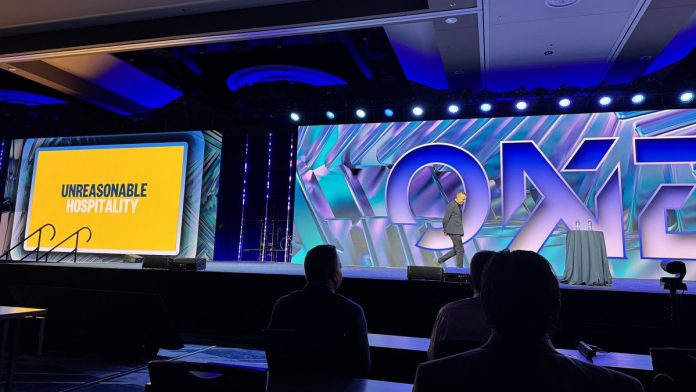
Guidara, the author of “Unreasonable Hospitality” and former co-owner of Eleven Madison Park, shared the story in his Nov. 18 keynote at Ingram Micro ONE 2026. It’s a restaurant story, but the lesson applies directly to MSPs: notice what a customer tells you, remember it, and make it matter.
Why hospitality is a business strategy
When Guidara joined Eleven Madison Park in 2006, the food was good but not great and the service was friendly but not very precise. Over the next decade, the restaurant went from two New York Times stars to four, from zero Michelin stars to three, and eventually to No. 1 on the World’s 50 Best Restaurants list.
Excellent food and service were the price of entry, he said. What set the restaurant apart was the decision to pursue how people felt with unusual intention. He argued that most competitive advantages – a better product, stronger service, a lower price – can eventually be matched. Relationships built through generosity take time and are much harder to copy. “The only competitive advantage that truly exists over the long term,” he says, “comes through hospitality.”
That idea echoed something Dham Pathervellai, Ingram Micro’s CTO, said earlier the same morning: AI models are becoming commodities, and context is the real edge. For MSPs, the two ideas fit together. Technology can surface what you know about a customer. People decide what to do with it.
Map every touchpoint, not just the obvious ones
Guidara realized his team was focused on the most obvious moments of a meal, the same ones every competitor focused on. So he closed the restaurant and had the whole team map every interaction with a guest, from the moment someone considered booking until long after they left. Opening the door. Unfolding a napkin. Washing hands in the restroom. The teams started with about 30 touchpoints, then 70, and after three hours had identified roughly 130 on average.
Then they looked for overlooked moments to improve. One was the check. Guests get impatient once they want it, but bringing it early makes them feel rushed. Eleven Madison Park’s answer was to pour each guest a splash of cognac when they seemed finished, leave the bottle on the table, and let them know the check was ready whenever they were. No one waited, no one felt pushed out, and the gesture cost little.
MSPs have a check moment too: the monthly invoice. So does onboarding, the first ticket, the after-hours outage, the QBR, and the day a client’s longtime employee leaves.
Three principles from the hot dog
Guidara broke the hot dog story into three lessons.
- Be present. If he’d been focused only on clearing the table quickly, he’d have missed the comment. Efficiency isn’t always the goal. Sometimes you have to slow down to notice an opportunity.
- Take the work seriously, not yourself. A hot dog was completely off-brand for a fine-dining restaurant, and it mattered more than anything on the menu. Protecting a brand too carefully can get in the way of making people happy.
- One size fits one. Hospitality means responding to each person as an individual, not applying a single script.
His team repeated those ideas in its daily pre-service meeting: “Be more present, take yourself less seriously. One size fits one.”
Make the care repeatable
Personal gestures don’t always scale, and Guidara said organizations shouldn’t limit themselves to ideas that do. But when an unscalable gesture works, look for a system that makes the underlying care repeatable.
His team ran a second exercise, recognizing patterns in moments that happen over and over, both good and bad, and deciding in advance how to respond. Engagements were one example. Guidara said couples got engaged at Eleven Madison Park at least twice a week, and the restaurant treated them to a complimentary glass of champagne. Then he polled the room: Had anyone here gotten engaged at a restaurant? Several of us raised our hands, and he called on me. “Sir, when you proposed to your wife, did the restaurant give you a complimentary glass of champagne?” he asked. I told him no. “Aw, that’s too bad,” he said, and went on with his talk.
A free glass of champagne is what most restaurants would offer, so his team looked for a way to make the moment more memorable. Guidara persuaded Tiffany & Co. to give the restaurant a thousand of its blue boxes, each holding a pair of champagne flutes. Newly engaged couples were served in those flutes and took them home in the box at the end of the meal.
He also created a role he called the Dreamweaver, a team member with no other job than helping colleagues bring their ideas for guests to life. Caring about hospitality isn’t enough, he said, if the organization won’t put resources behind it.
Putting unreasonable hospitality to work in an MSP
- Hold a touchpoint workshop. Bring your whole team, not just leadership, and map every interaction a client has with you, from the first website visit and sales call to onboarding, ticket updates, invoices, renewals, and offboarding. Aim for 100 or more.
- Fix your version of the check. Pick one overlooked moment, such as the monthly invoice, and redesign it. A short note summarizing what your team handled that month turns a bill into a reminder of value.
- List your recurring moments. New client go-lives, a client’s new hire, an employee departure, a major outage, and a client’s company anniversary all happen predictably. Decide how you’ll respond to each, and build it into your PSA workflows so it happens every time.
- Write things down. Train technicians and account managers to log personal details clients mention – a child starting college, an office move, a big contract win – so anyone on the team can act on them. This is where AI tools that summarize ticket and call history can help.
- Fund it. Give someone time and a small budget to make thoughtful gestures happen. It doesn’t need to be a full-time Dreamweaver, but it does need an owner.
- Use your team meetings. Share hospitality stories in your daily standup or weekly meeting so the habit sticks.
Guidara also pointed out that hospitality tends to cost less than marketing and often works better, because it gives customers stories they want to tell. For MSPs that depend on referrals, that may be the strongest argument of all.
He didn’t forget
Guidara ended his keynote by showing what he meant. The audience was still applauding and he was walking offstage when he stopped. “Oh wait, I forgot something,” he said. He went backstage, came back a few moments later with a bottle of champagne, walked down from the stage, and handed it to me.
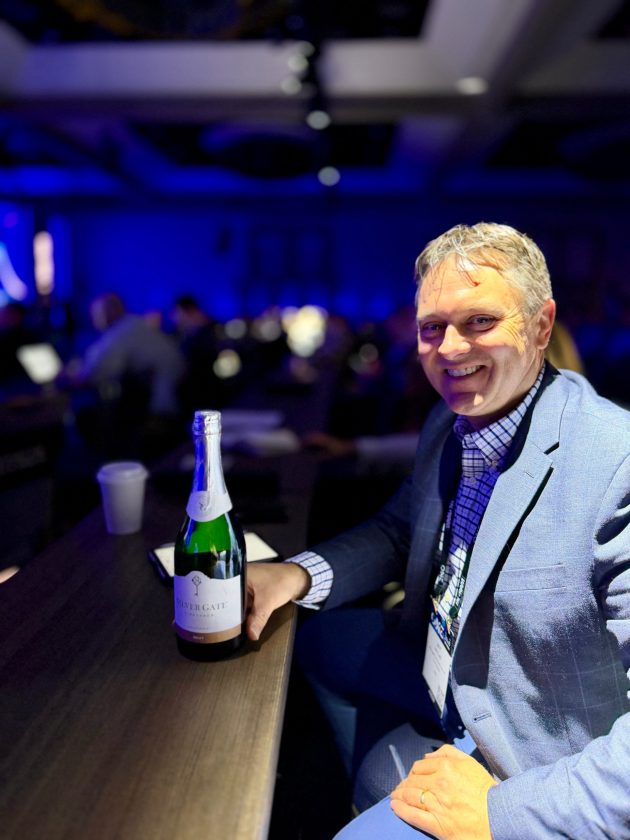 Will Guidara brought me this bottle after his keynote. Photo: WhiteFox
He had heard a one-word answer to a show of hands earlier in his talk, remembered it, and made it matter. For a room full of MSPs, it was the clearest lesson of the morning.
Related coverage from ONE 2026: Why Ingram Micro wants MSPs to see it as an intelligence partner and Ingram Micro wants to bring MSPs the opportunity before they ask.