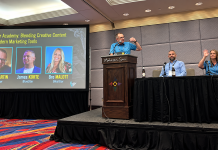
During the emerging technologies panel I attended at BlueStar’s VARTECH 2026 show at Mohegan Sun in Uncasville, Connecticut, the conversation kept returning to a practical question: How do channel partners turn new technology into a sustainable business?
For Managed Services Journal readers, that question should sound familiar. Recurring revenue, customer relationships, and ongoing support are central to the MSP model. The opportunity discussed at VARTECH is to extend that model into more of the customer’s operations, using robotics, connectivity, edge computing, and related services to address problems customers will pay to solve.
What stood out to me was how much of the discussion centered on business execution. Choosing technology is one step. Building the partnerships, sales processes, and financial discipline to support it requires a longer commitment.
Stack solutions to rebuild margin
Ben Simon, BlueStar’s emerging technologies business development manager, moderated the panel and set the stakes early. Margins are shrinking as costs rise, he said, and customers won’t pay proportionally more. Stacking solutions on top of the hardware, especially ones that generate recurring revenue, is how providers win that margin back.
Intel’s Rob Risany, director of ecosystem scale for high-growth technologies, described a channel partner that made the shift. The company had sold laptops, a business Risany compared to selling point-of-sale systems or handheld computers. It blended edge AI software into its offerings, built intellectual property for the verticals it served, and now sells only AI-enabled technology. The result is higher margins on higher-value products and, as Risany put it, a transition from “quote provider” to “full-on solution provider.”
Simon pointed to a simpler opportunity inside deals many providers already close. He asked attendees who sell connected devices to raise their hands, then to keep them up if they also sell the connectivity. About a quarter did. Carriers, he noted, sell the same Zebra and Honeywell devices but essentially give them away to win the service contract. His advice: “Don’t let them into the conversation.” Offering better multi-network connectivity through partners such as iONLINE lets the provider control the whole deal.
For MSPs that already manage customers’ networks, connectivity is a logical recurring service to keep in house rather than leave to a carrier.
Start with the customer’s operational problem
Risany also challenged attendees to reconsider how they define their expertise. A company that describes itself as a warehouse software provider can struggle to see where robotics or shipment tracking fits. A company focused on improving warehouse operations has more room to bring those capabilities into the conversation.
“Your job is to be an expert in your customer,” he said.
That is a useful starting point for MSPs exploring emerging technology. Understanding a customer’s network provides a foundation for deeper conversations about where work slows down, labor is difficult to find, or unreliable connectivity interrupts operations.
Buck Ward, CEO of Nexus AMR, pointed to dull, dangerous, and dirty jobs as candidates for automation. He described initial robot deployments averaging five or six units, with room to expand as customers see results. He also emphasized an operating-expense model and a value proposition tied to increasing revenue or reducing costs.
For an MSP, the first sales conversation can begin with the work a customer needs done and the cost of doing it today.
Build the offering through partnerships
A concern raised during the panel was the lack of internal expertise. How can a provider sell robotics or specialized connectivity when its team is still learning the technology?
The panelists described partnership programs that include joint customer calls, solution design, training, and technical support. Ward said Nexus AMR can help with site surveys and proposals. Carel Wessels, head of IoT solutions at iONLINE, described a joint sales program in which the channel partner remains the primary customer contact while vendor solution architects support the engagement.
Simon summarized his own invitation simply: “Bring me your problems.”
I saw a practical entry point here for MSPs. A provider with an established customer relationship can work with specialists to evaluate an opportunity and develop a solution. Participating in those conversations also helps its own team learn how to qualify and sell the next project.
The TECNexus Innovation Center in Ashland, Virginia, which Nexus AMR, BlueStar, and Intel founded together, was another resource discussed. Ward said about 30 VARs had visited this year, and he encouraged partners to bring customers to see robots operating and explore how automation might fit their businesses.
Write the RFP instead of answering it
Partnerships also change how providers can pursue larger projects. Simon asked how many VARs in the room liked receiving RFPs they had never seen before. None did. Those RFPs arrive with competition built in and leave the provider with little control.
His alternative is to help the customer write the RFP around the full scope of the problem, then bring in BlueStar to assemble the vendors needed to deliver it. That’s how one BlueStar partner won the City of San Diego’s EV project three years ago.
Look for the services around the deployment
The discussion also illustrated how technologies depend on one another in real-world environments.
Ward described connectivity problems his company encountered with robots in the field, particularly in hospitals. His experience reinforced the importance of networking partners in making automation work outside a controlled demonstration.
Wessels emphasized secure, scalable connectivity that can be managed across multiple locations. Brian Courtois, vice president of sales for the Americas at Celerway Communication, discussed growing demand for on-premises edge computing to support AI applications, with benefits for latency and cloud processing costs.
Courtois also noted that AI is making attackers more sophisticated. “If you’re doing networking in any way, you should be adding cybersecurity to that,” he said, “because if you’re not doing it, somebody else is going to do it.”
For MSPs, these dependencies deserve attention during discovery. A robotics opportunity may also require connectivity, security, and ongoing management. The business case should account for the services needed to keep the complete solution working.
Overhaul’s Marc Schrader, vice president of partnerships and business development, added another dimension: protecting high-value goods in transit through monitoring, intervention, and recovery. He said a cargo loss carries roughly a seven-fold impact once brand, inventory, and market effects are counted, so a stolen $1 million load can cost a business $7 million. According to Schrader, most Overhaul customers see a 400% to 700% return on investment within three to six months – money, he argued, that customers can put toward a provider’s services.
Schrader also cautioned that as operations become more automated, new security gaps appear, including points where human intervention is still needed. His comments highlighted opportunities that extend beyond the systems traditionally managed by IT.
An audience member made a related point that resonated with me: Existing IT contacts may not own the operational problem. Providers need to identify the people responsible for shipping, warehouse performance, labor, or other relevant outcomes and involve them in the discussion.
Give the practice a business model that fits
The panel’s most actionable advice concerned what happens inside the provider’s business.
Ward stressed patience and commitment, noting that emerging technology can involve longer sales cycles. He described partners investing in dedicated sales and marketing resources to develop the opportunity.
Sales compensation also needs attention. “Salespeople are coin-operated,” Courtois said, and a team paid on hardware transactions will struggle with offerings that are typically sold as managed services. Simon recounted situations where leadership wanted to pursue a new offering, but sales representatives didn’t understand how they would get paid. A recurring revenue strategy needs incentives that make the sales team willing to invest its time.
Risany was equally direct about financial management: “The worst thing you can do is attach an emerging technology to a legacy P&L.”
He urged providers to track costs and returns separately, recognizing that forecasting and operating rhythms differ from an established hardware business.
For MSP owners, the implication is to define how the practice will be measured before expecting it to scale. Training, vendor collaboration, and a longer sales cycle all consume resources. Those investments need visibility alongside the revenue they produce.
I left the panel with a clear starting point for providers considering this expansion: Choose a customer problem you understand, bring the right specialists into the conversation, and build a repeatable service around the outcome. Then give the practice the time, incentives, and financial attention it needs to grow.