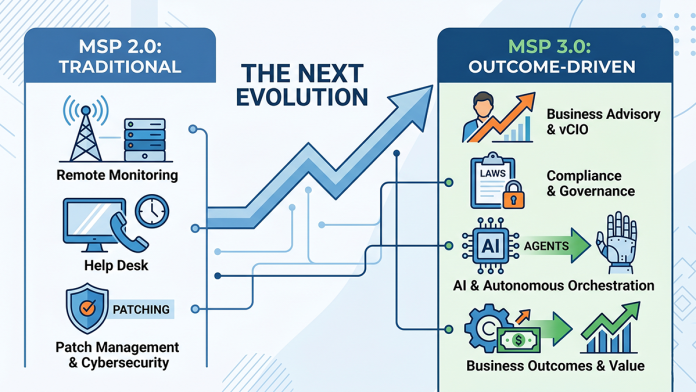
The managed services industry has never stood still. Over the past two decades, managed services providers (MSPs) have evolved from break-fix providers to proactive IT partners, building recurring revenue through remote monitoring, help desk support, patch management and cybersecurity services.
Today, however, another transformation is underway.
Automation, artificial intelligence and increasingly sophisticated management platforms are changing the economics of traditional managed services. Tasks that once required hours of technician time can now be completed automatically. Meanwhile, customers are becoming more focused on business outcomes than technology management.
The result is a new phase of industry evolution that many analysts and channel leaders are calling MSP 3.0. For MSP owners, the question is no longer whether change is coming. The question is whether their businesses are prepared to adapt.
The help desk is no longer the destination
Traditional managed services remain essential. Clients still need endpoint management, network monitoring, cybersecurity protection and responsive support. The challenge is that these services are becoming increasingly standardized.
Modern RMM platforms have evolved into autonomous IT orchestration platforms. Instead of simply generating alerts and automating basic patching, top-performing providers are shifting to predictive self-healing protocols. By leveraging machine learning, these modern orchestration systems can predict hardware failures up to six months in advance, triggering condition-based maintenance before a client even encounters a risk.
As a result, many clients view legacy, reactive core managed services as expected rather than differentiated. They no longer want to see ticket counts; they want to see prevention metrics. To discover how automated operations are redefining standard service delivery, read our analysis on Orchestrating a digital workforce: The next MSP scale lever.
This trend is occurring at a time when the managed services market continues to grow rapidly. According to research from Grand View Research, the managed services market is expected to grow from $401.2 billion in 2025 to $847.4 billion by 2033, nearly doubling in size over the forecast period. The opportunity remains significant, but competition is increasing as more providers offer similar services. That means MSPs must identify new ways to stand out.
Clients are buying outcomes, not tools
Many MSPs still position themselves around technical capabilities. They talk about uptime, monitoring, backups and cybersecurity tools. While these capabilities matter, they are rarely the reason a customer chooses a provider. Business leaders care about revenue growth, operational efficiency, risk reduction and employee productivity.
Consider a typical conversation around Microsoft Copilot or autonomous digital workflows. A traditional MSP might focus on deployment, licensing and configuration. An MSP 3.0 provider focuses on how these tools can help employees save time, automate workflows, improve customer service and increase profitability.
The technology remains important, but it becomes a means to an end rather than the primary value proposition. This shift requires MSPs to speak the language of business outcomes. It also requires deeper engagement with executive stakeholders rather than relying exclusively on IT contacts.
The rise of the strategic MSP
As traditional services become more automated, MSPs have an opportunity to move higher up the value chain. The most successful providers are increasingly positioning themselves as strategic advisors rather than outsourced IT departments. Several service categories are emerging as particularly attractive opportunities:
- Virtual CIO and business advisory services: Organizations continue to struggle with technology planning, budgeting and digital transformation initiatives. MSPs that provide strategic guidance can strengthen customer relationships while generating higher-margin recurring revenue.
- Continuous compliance and governance: Regulatory requirements continue to expand. In North America, comprehensive privacy laws are now in effect in 19 states – with recent enactments in Indiana, Kentucky, and Rhode Island. Furthermore, domestic clients selling internationally must increasingly navigate the strict transparency requirements of global regulations such as the EU AI Act. By offering Compliance-as-a-Service (CaaS) and managing data security posture, MSPs can position themselves as the gatekeepers of insurability for clients seeking cyber insurance policies. For a complete breakdown of how to build this high-margin revenue stream, check out our guide: The MSP growth playbook has changed.
- AI orchestration and curation: Customers are eager to leverage AI but often lack clear implementation strategies. They are also highly vulnerable to shadow AI, where employees leak proprietary data into unapproved tools. This creates opportunities for MSPs to act as curators of intelligence, helping clients implement AI governance frameworks, set up multi-agent orchestration layers, and safely deploy autonomous digital labor.
- Advanced behavioral cybersecurity: Attackers are leveraging AI to launch sophisticated, polymorphic phishing campaigns and adversary-in-the-middle relay attacks that bypass traditional secure email gateways and standard push-notification MFA. MSP 3.0 providers are updating their security stacks to deliver AI-driven behavioral analytics and phishing-resistant authentication (such as FIDO2/WebAuthn) to defend against these context-aware threats.
Building an MSP 3.0 roadmap
The transition to MSP 3.0 does not require abandoning traditional services. Instead, it involves building additional layers of value on top of an existing managed services foundation.
Business owners should start by evaluating their current revenue mix. If most revenue comes from help desk support, device management, and infrastructure services, there may be an opportunity to expand into more strategic offerings. This shift often requires moving from legacy seat-based billing to value- or outcome-based pricing models, ensuring that revenue reflects the business value delivered rather than just the hours logged.
The next step is identifying customer pain points that extend beyond IT operations. What business challenges are customers facing? Where are they struggling to improve productivity? What compliance requirements are creating concerns? How are they approaching AI adoption? The answers often reveal new service opportunities.
Finally, MSPs should invest in developing consultative skills throughout their organizations. Technical expertise remains important, but the ability to connect technology investments to business outcomes will become increasingly valuable.
The future belongs to outcome-driven providers
Managed services are not disappearing. In fact, demand for outsourced technology expertise continues to grow. What is changing is the definition of value.
Google Cloud research indicates that 74% of organizations deploying AI at scale see ROI within the first year, proving the market is ready for high-value automation. The MSPs that thrive over the next decade will not simply manage infrastructure more efficiently than their competitors. They will help customers achieve measurable business outcomes, navigate emerging technologies, and make better strategic decisions.
In other words, they will become indispensable business partners rather than technology vendors. That is the promise of MSP 3.0.